
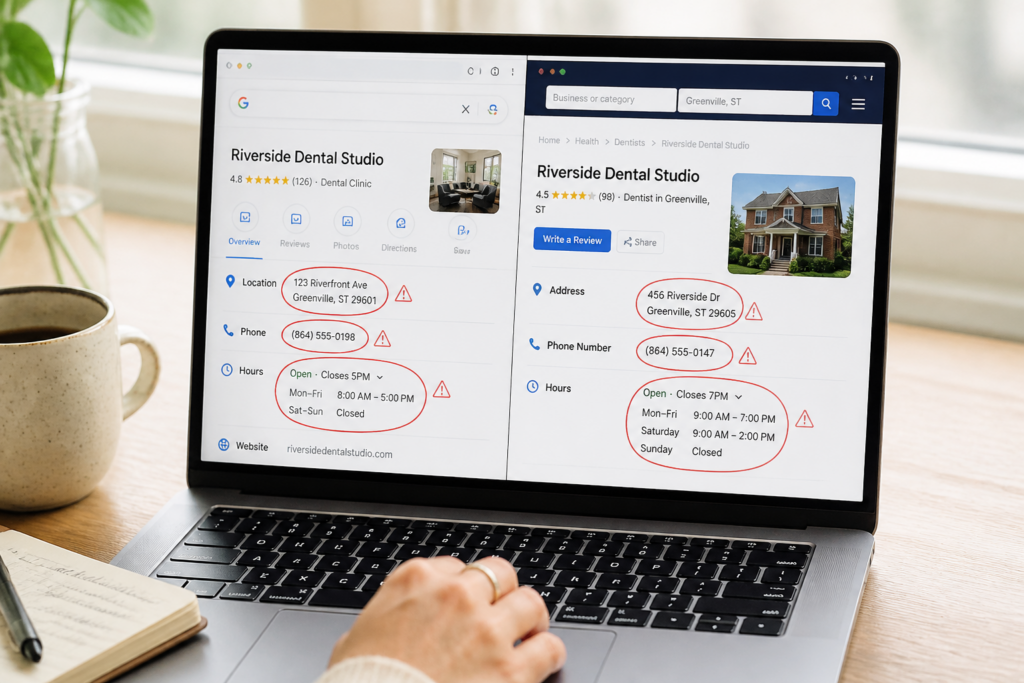
If you’ve been wondering about business name address phone consistency, here’s the plain-English version for Salem-area owners. By Melody Campbell, The Small Business Guru
Imagine a Salem painter whose business has moved twice. His Google listing shows one address, his Facebook page shows another, an old directory still lists a phone number he stopped using, and his website says something slightly different again. A customer tries to find him and gives up after the second wrong number.
Inconsistent business information is one of the most common and most fixable problems I see. In this post I’ll explain what NAP consistency means in plain English, how to check your own listings, and why keeping your business name, address, and phone number the same everywhere helps both customers and Google.
In a nutshell
- NAP stands for Name, Address, and Phone number. It should read the same everywhere your business appears online.
- Mismatches confuse customers and can make search engines less sure about who you are.
- Checking is simple: search for your business, write down what you find, and fix what’s off.
- It’s a steady habit, not a one-time chore. Check again whenever something about your business changes.
What does “consistent” mean?
NAP is just a shorthand for your business name, your address, and your phone number. Consistent means those details are the same everywhere: on your website, your Google Business Profile, your social pages, and every directory or listing site.
The little differences matter more than you’d expect. “Suite 200” in one place and “Ste. 200” in another is a small mismatch. “Smith Plumbing” in one place and “Smith Plumbing and Drain LLC” in another is a bigger one. A tracking phone number on one site and your real number on another is a classic mix-up. To a person it’s a nuisance. To a computer reading hundreds of listings, it can look like more than one business.
Pick a single version and use it everywhere. Write it down exactly: the name as customers know it, the address in your chosen format, and the one phone number you want customers to call.
How do I check?
You can do a decent first pass in under an hour. Here is how:
- Write down your correct information. Name, address, phone number, website, and hours. This is your master copy.
- Search for your business name. Look at Google, Maps, Bing, Facebook, Yelp, and any directories common for your trade.
- Search your phone number. Old numbers often surface listings you forgot about.
- Search your old address, if you’ve moved. Those leftover listings are a frequent source of confusion.
- Record what you find. A simple list works: where it is, what it says, and whether it’s correct.
- Mark the mismatches. Note what you’ll fix first, starting with the most visible ones.
Check your Google Business Profile first because it’s usually the most visible. Then work through your website, social pages, and the larger directories. Industry-specific directories matter too: a lash artist might be listed on booking sites, and a septic company on home services pages.
Why does it help?
It helps in two ways. First, it helps customers. When someone sees the same name, address, and number in several places, they feel more confident that you’re real, current, and open. That’s a big part of the trust I describe in what customers need to see before they reach out.
Second, it helps search engines and AI tools understand who you are. They collect information from many places, and when the details agree, there is less room for error. When they don’t, a tool may show the wrong phone number or skip you. I can’t promise any particular result, but I’ve seen that clean information is a solid foundation.
This sort of cleanup was part of the Corvallis tree service case study. That family-owned business saw its local voice share, meaning how often it appeared in the top three results across its service area, go from 75% to 94% in 90 days. The work included a Google Business Profile cleanup, corrections across 50+ directories, a steady review-request habit, and weekly profile posts. Results vary by business and nothing is guaranteed, but consistency was a key piece.
What are the most common mistakes?
Here’s what I see again and again in Salem, Keizer, and the Willamette Valley:
- Old addresses from a move. The business relocated, but half the directories still show the previous spot.
- Different phone numbers. Call-tracking numbers, an old cell number, and the main line end up scattered around.
- Name variations. The legal name, the nickname, and the sign out front all appear in different places.
- Duplicate listings. Two profiles for the same business split your reviews and confuse customers.
- Home-based and service-area businesses. Many contractors work from a home address they don’t want to show. Google has settings for service-area businesses, so use those instead of publishing an address you’d rather keep private.
- Forgotten accounts. A listing you created years ago may be tied to an email you can’t reach. Sorting out who controls your accounts comes first.
How do I fix what I find?
Start with the places that matter most and work down. Here is the order I use:
- Fix your Google Business Profile and your website first, so they match your master copy exactly.
- Update your main social profiles.
- Claim and correct the big directories where customers look.
- Request removal or merging of duplicates, and be careful not to lose reviews.
- Work through smaller directories and trade-specific listings.
Some owners handle this by hand, and others use a listing service to push corrections to many directories at once. Either way works as long as you have a master copy and you keep it up to date. The wider approach fits into local SEO and into the Local Visibility Framework, where accurate listings support being found.
What to do this week
- Write your master copy of your business name, address, phone number, website, and hours.
- Search for your business and your phone number, and list every place that shows up.
- Correct your Google Business Profile and website first.
- Fix your top three directories and social profiles.
- Look for duplicate listings and note them for cleanup.
- Put a reminder on your calendar to recheck every few months and whenever you change anything.
Frequently asked questions
Does “Street” versus “St.” really matter?
Small differences are usually understood, but it’s best to choose one format and use it everywhere. The less variation you leave, the fewer chances for confusion.
Should I use a tracking phone number?
You can, but be careful. Many businesses use their main number as the primary one and add a tracking number as an additional line, so the main details stay consistent.
What if I don’t want my home address public?
Many contractors and beauty professionals work from home. If you travel to customers, you may be able to hide your address and list a service area instead. Check the current rules before you change anything.
How often should I check my listings?
A good rhythm is a quick review every few months, plus a full check whenever you move, change your phone number, or rename your business.
Related reading: who really owns your Google Business Profile
I’m Melody Campbell, The Small Business Guru, and I help business owners in Salem, Keizer, and the Willamette Valley get found, get trusted, and get chosen.
Get Found. Get Trusted. Get Chosen.