
If you’ve been wondering about google maps local ranking, here’s the plain-English version for Salem-area owners. By Melody Campbell, The Small Business Guru
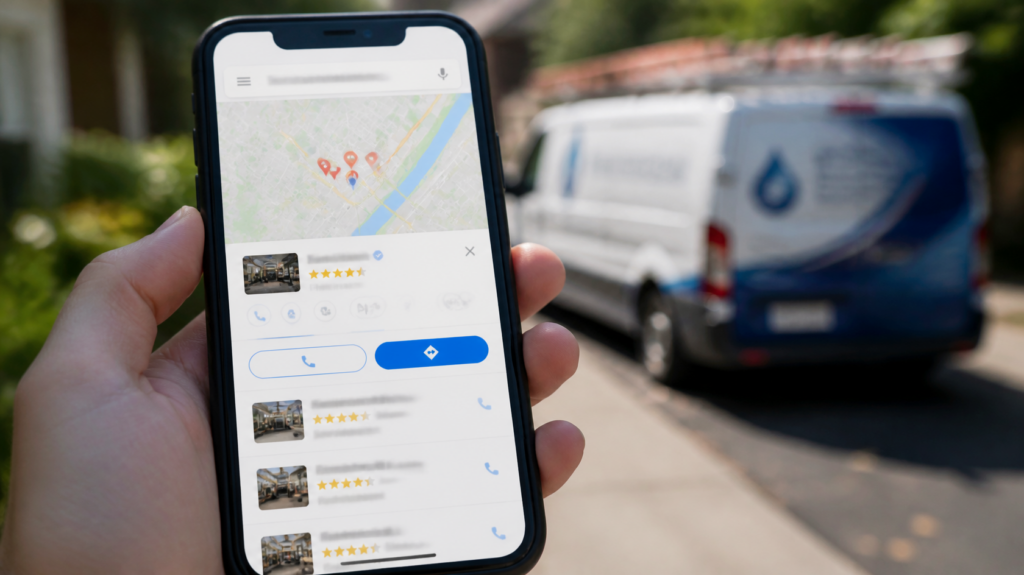
“How do I get on the map?” is the question I hear most from Salem plumbers, septic companies, landscapers, and mobile beauty pros. They mean the Google Maps results, that short list of three businesses with pins that appears when someone searches for a service nearby. Those spots get a lot of attention, and they feel like a mystery.
The good news is that the basics are not a mystery. In this post I’ll walk through what helps your business show up on Google Maps in plain English, what you can do this week, and why anyone who guarantees a ranking should make you nervous.
In a nutshell
- Google tends to look at relevance, distance, and prominence when it decides who to show on the map.
- A complete, accurate Google Business Profile, steady reviews, and a clear website all help.
- You can’t control where a searcher is standing, so results will vary.
- No one can guarantee a ranking, and honest help sounds like “can help” instead of “will.”
How does Google Maps decide who to show?
Google has described three general ideas behind local results: relevance, distance, and prominence. Here is what each one means for you.
- Relevance: How well your business matches what the person searched for. If someone searches for a mobile esthetician and your profile never mentions mobile services, you’re less clear.
- Distance: How close your business, or your service area, is to the searcher. You can’t change where your customers are standing, but you can describe your service area accurately.
- Prominence: How well known and trusted your business seems, based on things like reviews, mentions around the web, and your website.
You can’t fully control the distance part, which is why two people in different parts of Salem may see different results for the same search. It’s also why I never trust a one-time check that says “you’re number one.”
What helps?
Here are the things I focus on first, in roughly this order.
1. A complete and accurate Google Business Profile
Your Google Business Profile is the foundation. Choose the right main category, add every service you offer, list your hours, describe your service area, and keep your name, address, and phone number accurate. A profile with blanks leaves Google guessing.
2. Real reviews, collected steadily
Reviews are a big part of how customers decide, and they’re part of how prominent you look. Ask happy customers regularly, make it easy, and reply to every review, good or not so good. I never recommend buying or faking reviews. They’re against the rules and customers can tell. See reviews, trust, and tracking calls for more.
3. Photos and posts
Real photos and regular posts show that your business is active. They also give customers more reasons to choose you.
4. A clear website
Your website should say what you do and where you do it. A separate page for each main service, such as drain cleaning, septic pumping, or lash lifts, helps both customers and search engines. Take a look at what every local website should make clear.
5. Consistent listings around the web
When directories show the same name, address, and phone number as your profile, it removes confusion. This is part of local SEO.
Does it matter if I work from home or travel to customers?
Yes, and it’s important to be honest and careful here. If you don’t have a storefront, Google lets you hide your street address and list a service area instead. Don’t use a fake address or a mailbox store just to look closer. That breaks the rules and can get your profile suspended.
For service-area businesses, describe the cities you serve clearly, such as Salem, Keizer, and nearby Willamette Valley towns. Be realistic. Listing forty towns you rarely visit doesn’t help.
How do I know if I’m making progress?
Don’t rely on a single search. Instead, look at what your Google Business Profile reports each month: calls, requests for directions, and visits to your website. Write the numbers down in a simple notebook or spreadsheet so you can compare month to month.
Also pay attention to the human signals. Are more callers saying they found you on Google? Are new reviews coming in? Did the front desk or your own voicemail get busier? Small, steady movement in the right direction is a good sign, even if you haven’t hit the top of the map. If you want a second set of eyes, a free review can show you where you stand today.
What to do this week
- Search for your main service on your phone while at a few different locations around town, and note where you show up.
- Open your profile and fill in every blank: services, hours, description, service area, and photos.
- Check that your main category is the best match for your top service.
- Send review requests to your last five happy customers.
- Make sure each main service has its own page on your website.
- Post one helpful update with a real photo.
Can anyone guarantee a ranking?
No. Google decides what to show, and it changes things often. Anyone who promises you the top spot is guessing or selling something. What a good partner can do is clean up what’s wrong, strengthen what’s right, and measure whether more people are finding and contacting you.
As one example, a family-owned Corvallis tree service improved its local voice share, meaning how often it appeared in the top three results across its service area, from 75% to 94% in 90 days. That followed Google Business Profile cleanup, corrections across 50+ directories, a steady review-request habit, and weekly profile posts. Results vary by business and nothing is guaranteed, but the full case study shows what kind of work was involved.
What mistakes should I avoid?
- Stuffing keywords into your business name. It can get you in trouble and looks unprofessional.
- Creating duplicate listings for the same business.
- Ignoring negative reviews instead of replying calmly and honestly.
- Changing your profile details constantly without a reason.
- Paying for fake reviews or “guaranteed rankings.”
Frequently asked questions
How long does it take to show up on Google Maps?
It depends on your starting point, your competition, and how much needs fixing. Some improvements show up in weeks, others take months, and I can’t give an exact timeline.
Why do I show up for some people and not others?
Results depend partly on where the searcher is and what they typed. That’s why two people can see different results at the same moment.
Do I need a website to be on Google Maps?
You can have a profile without one, but a clear website gives customers and Google more information. I recommend having one.
Should I pay for Google ads to get on the map?
Ads are a separate option that can place you in sponsored spots. They don’t replace a strong profile, reviews, and website, and they cost money every time they run.
I’m Melody Campbell, The Small Business Guru, and I help business owners in Salem, Keizer, and the Willamette Valley get found, get trusted, and get chosen.
Get Found. Get Trusted. Get Chosen.